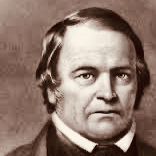
William Miller was a clergyman from Massachusetts who was certain Jesus would return on October 22, 1844. Your reading this now says enough about that theory.
This was not the first time Miller predicted Jesus’ return. In 1822 Miller postulated that Jesus would be back on earth ”on or before 1843,” a very wide, cushiony window that Jesus didn’t have the common decency to walk through. This is not without context. If you’ve ever read the gospels it’s clear Jesus didn’t observe most decencies, common or otherwise.
At the time of Miller’s predictions America was going through the Second Great Awakening. For those unfamiliar with this historical event, America first woke up sometime in the early-to-mid-1700s, but instead of getting out of bed hit Snooze. Subsequently there was a Third Great Awakening in the late-1800s/early-1900s, and some scholars suggest there was a Fourth Great Awakening in the 1960s-80s; all of which indicates that Americans are bad sleepers.
Miller’s predictions received a lot attention. Many people followed him and his writings and, like Miller, came to believe Jesus’ return was imminent. As you might imagine, when Jesus ghosted 1843 things got a little squidgy. Ever resourceful, Miller updated his predictions, only to have Jesus demur; Miller made further tweaks but Jesus remained impassive; Miller made more changes and revisions and so on until finally October 22nd arrived and—well, you know.
There are many lessons one could take from this. Most of them shade snarky and condescending and I’ll try to avoid them. Mocking Miller for the absurdity of his beliefs can make us feel cozily superior to him, but it doesn’t change the reality that each of us believes a host of things that are kooky, silly, wacky, outright nonsensical, irrational, contradictory, inconceivable and absurd. Miller’s mistakes occurred in the same location where most of our mistakes take place: he grossly misunderstood time.
In this, Miller was like 99.99% of everyone else, and I am not exempting myself from that category. The truth is that I don’t understand piles of small things, such as oysters, hang-nails, irony or the changing colors of maple leaves. Further, I don’t understand my own self, and am not foolish enough to think this self that can’t understand it’s self can somehow contort itself into a proper understanding of time.
I can also sympathize with apocalyptic hopes. Life can be a slog. Telling yourself that slog is not only meaningful but will end with something grand is relatable. I don’t find Miller’s vision especially appealing, but I understand the impetus behind it.
Like Miller, most of us think there’ll not only be a future, but that it’ll be one we can know, predict and control; like Miller, we plan for this future and twist ourselves into contorted knots to ensure it will shape up how we feel it should; like Miller we fear ourselves into anxiousness, doubts, despair, illusions, fantasies, hopes and aspirations; like Miller, everything discussed in this sentence is literally un-real: an illusion, a distortion and avoidance, for the simple fact that none of it is now, all of it is then, and then is an experiential impossibility.
Is there a future? I don’t know, but I do know that if it exists it’ll only be experienced now and never in the future.
Can the future be controlled? Try it and report back.
Can the future be planned for? Sure, but only loosely, in the way you can carry an umbrella if the forecast calls for rain. (A more accurate but equally more depressing image would trade umbrellas for funeral shrouds.)
Is it possible to live in the future? Most of us skip living now, and until that’s addressed what difference could this make? Not-living is not-living.
Do I have an uplifting conclusion? Yes.
As I’m writing this the maple trees outside my window are rusting. The color of the sky is slowly turning from blue to patchwork gray. The cat yawns and his fur shudders as he twists himself across the chair. The last sip of coffee is cold and my toes sweat inside my slippers and my stomach gurgles its way through breakfast, and as long as I stay right here and now it is experientially impossible for anything to be wrong.
The uplifting conclusion is an invitation. Try it and see.