I often encounter typos when reading. Typos are those little lexical oopsiedoodles that may or may-not survive AI. Will a book written by a human have errors? Hopefully so, because then you’ll be farily certain it was written by a human, although this may only be true until the algorithms figure out we’re drawn to errors and begin incorporating them. All of this is predicated on the potentially silly notion that humans will continue to write and read books…
For reasons involving my high school English teacher, I can’t not-notice a typo when I’m reading. Most of these are inane—a missing comma, an extra apostrophe, “they” instead of “the.” Occasionally you get lucky, as I did recently with this one:

(The key portion is “According to T.E. Lawrence, as portrayed in David Lynch’s film Lawrence of Arabia…”)[1]If you’re curious this is from Stephen R.L. Clark’s How the Worlds Became, a wonderful meditation on how we ongoingly tell myths to understand our places in the universe; like … Continue reading
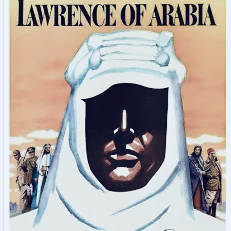
Lawrence of Arabia is a movie about T.E. Lawrence, a British army officer/diplomat/archeologist who famously mucked about the Middle East during the first World War. Lawrence’s exploits earned him the nickname “Lawrence of Arabia.” I find this impressive. Given the communications at the time, it’s astounding that members of an entire landmass knew this man by one name. And what a name to be known by! I’m certain T.E. emphasized Lawrence, but if I were writing the script I’d have had everyone across Palestine call him Larry.
Lawrence wrote extensively. I’ve never read these and can’t speak to their qualities. But if you’d like to explore a dashing British war hero/misogynist/colonialist, I highly recommend George MacDonald Fraser’s Flashman Papers, which are a true gem. There are a million things you could read, with or without typos, and Flashman should be one of them. Seriously, do yourself a favor.

Although they lived at the same time, traveled extensively and wrote prolifically, T.E. Lawrence is not to be confused with D.H. Lawrence. D.H. is one of those very unique writers who managed to write amazingly and incompletely, often simultaneously. D.H. is most renowned for what-were-then sexually graphic novels such as Sons and Lovers, Women In Love and Lady Chatterly’s Lover. His books magnetized censors and were frequently banned, probably because old D.H. was comfortable with a four-letter word that and sounds like a football play often run on fourth-down. Reading these books now is an amazing study in how wildly things have changed over the past 100-years.
(If you’re interested in D.H.’s work, I prefer his essays and non-fiction to his fictions. Either way you go, Lawrence had a great eye and a sharp mind and was tremendously unique. If you want an updated version, Geoff Dwyer has been hewing a Lawrencian course for years and much of his work is stellar.)
A portion of T.E. Lawrence’s life was turned into a movie titled—you guessed it, Lawrence of Arabia. Lawrence won seven (7!) Oscars, though many believe it would have won more had the title been changed to Larry of Arabia. Lawrence was directed by David Lean, a British movie-man who also directed The Bridge on the River Kwai, Doctor Zhivago, and others. Most of Lean’s movies were made in the 50’s and 60’s, and I’ve seen all of the above. I used to watch them on TV with my grandparents. Like most of their generation, my grandparents loved the movies in a way most of us can no longer relate to.

** David Lean **
Occasionally you’ll hear older people chide today’s youth with lines such as, When I was young we didn’t get bored! I don’t know if that’s true, but if it was the only reason is because they had the movies. My grandparents loved almost all movies, but not equally. They gave priority to musicals, screwball comedies and war movies in which the good guys triumphed.
Like Lawrence’s sexual licentiousness, musicals have aged in curious ways. We still make these—you can find piles of them in East Indian/Bollywood settings—but rarely do we make them for adults. Most of them are animated and aimed at young children, probably for this simple reason: most readers can likely still sing their way through Aladdin, Little Mermaid, Moana, and so on. I’ll get you my pretty, the witch once promised, and she was right.
A caveat is necessary in discussing war movies: Good Guys is obviously relative. In my grandparents’ case it referred exclusively to what we can loosely think of as The Allied Countries, aka America, though they had a linguistic soft spot for Brits and accepted Frenchmen who clung properly to our coattails. Movies that explored negative aspects of war—from Dr. Strangelove to Apocalypse Now to Full Metal Jacket to Platoon—were unwelcome in our house. Curiously, my grandparents loved the TV show M*A*S*H. I can only explain this by assuming that Klinger’s cross-dressing made them giggle loudly enough to miss Hawkeye’s criticisms.
I haven’t watched David Lean’s Lawrence of Arabia in years and won’t pretend to summarize it here. I remember enjoying it as a child, but in truth enjoyed just about anything on TV when I was younger. However, I will note that there’s no way you could ever confuse it with any movie made by David Lynch.
I can see the confusion in this typo. They’re both Davids, and Lynch and Lean aren’t that far off. I also like to hope this wasn’t accidental and was placed there simply so this could be written.
David Lynch was an American TV and movie-man who died last year. Like Lean, Lynch won many awards. Unlike Lean, Lynch’s shows and movies are… well, I don’t know what they are? They’re weird and funny, symbolic, dark and violent and sexual, and uniquely critical of the joys we receive when watching movies that emphasizes any of the nouns I just wrote. They were not movies I watched with my grandparents, and the reason for that may best be summed up in the following quote from Lynch:
“I don’t know why people expect art to make sense. They accept the fact that life doesn’t make sense.”
This is not how my grandparents watched movies nor is it why they watched movies. Even at their wackiest the Marx Brothers still made sense. This also isn’t how my grandparents lived. I’m including this quote to contrast Lynch with my grandparents and am in no way endorsing Lynch’s perspective, for the simple reason that his critique is predicted on an idea of sense that must have come from somewhere in life. Further, when would you know enough to conclude that life didn’t make sense? Some times things don’t make sense and other times they do. At what point can you confidently call it? David Lynch lived for eighty-years—I can’t imagine that was sufficient to make such an assertion about the entirety of life, though it may tell us much about how Lynch experienced things.

** David Lynch **
I read the typo above a week ago and have been trying ever since to imagine what Lynch’s version of Lawrence of Arabia might have looked like. I have a host of ideas, including Kyle MacLachlan in a keffiyeh, an oversized talking hairless cat, and Dennis Hopper lip-syncing “I Can Show You the World” from Aladdin. Sadly, none of those congeal, which may be the most Lynchian outcome imaginable.
If there’s a heaven and we’re still interested in movies upon arrival, perhaps we can convince Lynch to take a shot at old T.E.’s life. (If that doesn’t interest him, perhaps he could do a version based on D.H.’s life?) Until then, we’ll have to content ourselves by watching Blue Velvet side by side with readings of Fraser’s Flashman. I haven’t tried this and didn’t “think” of it until my fingers typed the idea just now, but if all of these words were necessary for us to arrive here, then it was worth it.
References
| ↑1 | If you’re curious this is from Stephen R.L. Clark’s How the Worlds Became, a wonderful meditation on how we ongoingly tell myths to understand our places in the universe; like everything I’ve read by Clark, it’s excellent, and if I can someday be even 1/8th as good at writing as he is, I’ll consider myself a success. |
|---|